
Description
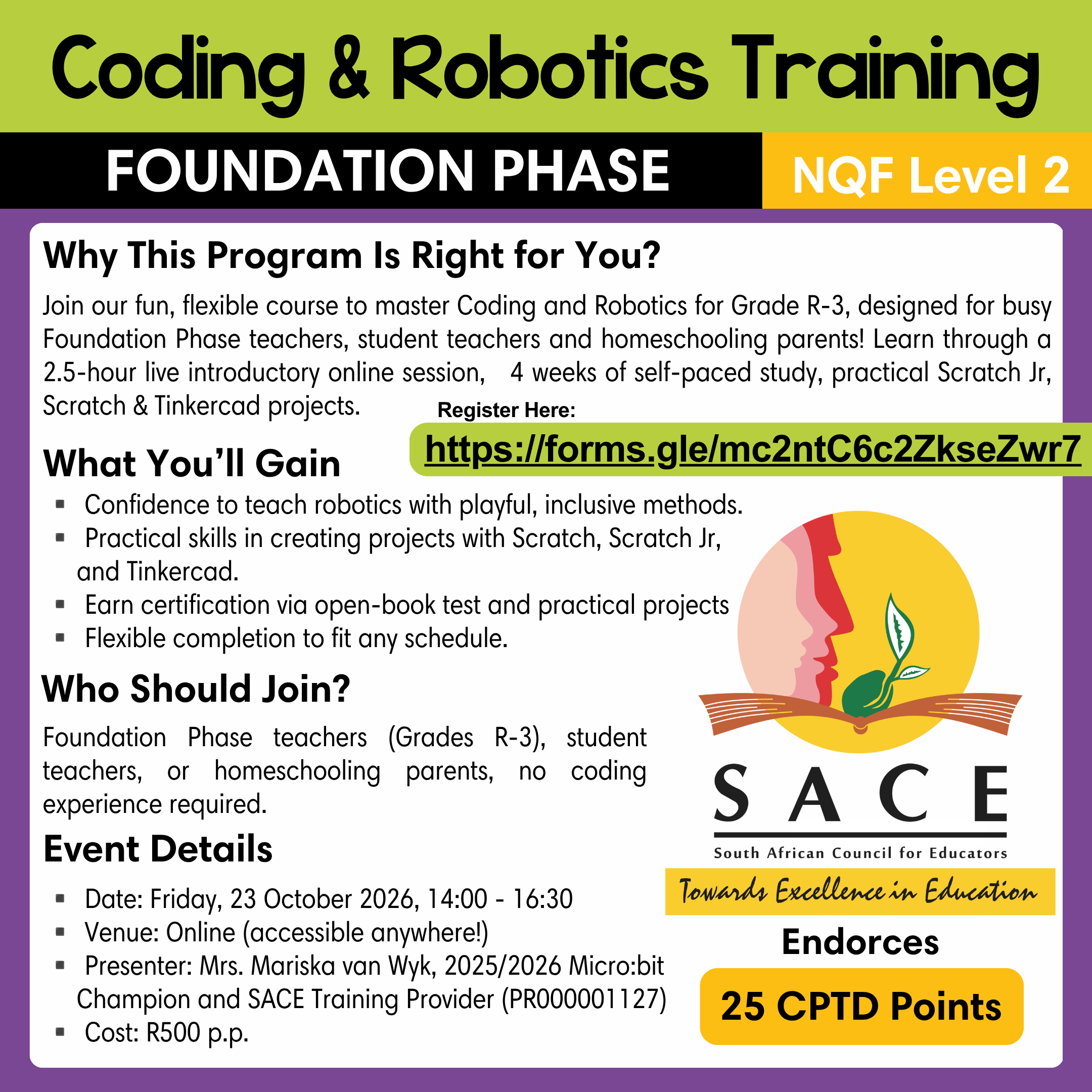
Coding & Robotics Training
Foundation Phase | Aligned to NQF Level 2 | Gr. R–3
Starts: Live Introductory Session – Friday, 23 October 2025 (14:00–16:30)
Cost: Only R500 (Invoice issued after registration)
Format: 100% Online (2.5-hour Live Intro + self-paced study + practical projects)
There are no due dates for submissions; you complete everything online in your own time, at your own pace, in a structured and supported environment.
Payment for training courses is not processed online; an invoice will be sent to you after registration.
How the Course Works
The course is completely online and designed for busy educators. It begins with a live introductory session on Friday, 23 October 2025 from 14:00–16:30, after which you are added to a Google Classroom. You then work through the modules and practical projects (Scratch Jr, Scratch, Tinkercad, and a simple introduction to AI) at your own pace in a well-structured environment. Most participants complete the course within approximately 4 weeks. On completion of the open-book test and practical projects (minimum 80%), your certificate is issued. The approach supports NQF Level 2 autonomy descriptors: working in a disciplined manner within a structured environment and managing your own time effectively.
Who Should Take This Course?
This programme develops basic operational knowledge and practical skills in coding, robotics and introductory AI concepts suitable for Foundation Phase teaching. No prior coding experience is required.
-
- Foundation Phase Teachers (Grades R–3) who want to confidently introduce playful coding, robotics and simple AI ideas aligned with the DBE Coding & Robotics curriculum.
- Student Teachers seeking practical, classroom-ready skills and a certificate that supports their professional development.
- Homeschooling Parents who want simple, age-appropriate ways to introduce computational thinking and early AI awareness at home.
- Educators looking for SACE-endorsed professional development with flexible completion.
Note: No prior coding or robotics experience is required.
What You’ll Gain (Aligned to NQF Level 2 Descriptors)
- Basic operational knowledge of Scratch Jr, Scratch, Tinkercad and simple AI concepts for Foundation Phase contexts.
- Ability to use these common digital tools to select and apply known solutions to well-defined routine classroom problems (e.g., creating simple sequences, stories, designs or recognising patterns).
- Confidence to teach coding and robotics using playful, inclusive methods that support computational thinking, and to introduce age-appropriate AI ideas (such as how computers can recognise patterns or follow instructions).
- Practical projects completed in a structured environment, with the ability to organise and present your work clearly.
- Certificate on successful completion of the open-book test and practical projects.
- 25 SACE CPTD Points (endorsed by the South African Council for Educators).
Course Curriculum
The curriculum develops basic operational competence with digital tools and supports the practical application of known solutions in familiar Foundation Phase contexts:
- Introduction to Coding, Robotics & AI in the Foundation Phase
Basic operational knowledge of computational thinking (sequences, patterns, simple algorithms) and an age-appropriate introduction to AI. Explore simple ideas such as how computers follow instructions, recognise patterns, and make everyday tools “smart”. Understand the classroom environment and DBE Coding & Robotics aims. - Scratch Jr for Grades R–1
Using a common tool (Scratch Jr) to create simple sequences and stories. Applying known solutions to routine problems such as sequencing events or creating short animated stories that support early literacy and numeracy. - Scratch for Grades 2–3
Extending operational knowledge with Scratch to build interactive projects. Selecting and applying known techniques (sequences, simple loops, events) to solve well-defined classroom challenges. Optional simple links to pattern recognition and AI-related ideas. - Tinkercad Design Basics
Using Tinkercad as a common design tool to create simple artefacts. Applying known design steps to routine tasks linked to classroom themes (supports design thinking and simple product creation). - Planning, Assessment & Reflection
Collecting, organising and reporting on practical projects. Reflecting on teaching practice, including how to introduce coding, robotics and simple AI ideas inclusively, and managing completion of tasks within a structured timeframe.
Accreditation & Recognition
- Aligned to NQF Level 2 Descriptors – The course develops basic operational knowledge, the ability to use common digital tools, and the capacity to apply known solutions to well-defined routine problems in a structured learning environment.
- SACE Endorsed – ATEACHERSCUP is a registered SACE Training Provider (PR000001127). This course is endorsed for 25 CPTD Points.
- Presenter – Mrs. Mariska van Wyk, 2025/2026 Micro:bit Champion and SACE Training Provider.
- Certificate of Completion – Issued by ATEACHERSCUP on successful completion (above 80%) of the open-book test and practical projects.
- Classroom Relevance – Practical skills support the implementation of the DBE Coding & Robotics curriculum for Grades R–3, including early awareness of AI concepts.
Our Philosophy
For Grades R–3 we prioritise joyful, play-based learning that builds foundational computational thinking and gentle AI awareness within a supportive structure:
- Playful & Inclusive – Every child can participate through simple sequences, stories, designs and pattern activities.
- Hands-on & Creative – Learners (and teachers) create projects using Scratch Jr, Scratch and Tinkercad while exploring simple AI ideas.
- Teacher Confidence First – You gain basic operational skills you can apply immediately in familiar classroom contexts.
- Structured Flexibility – Complete the course at your own pace within a clear, supported framework.
Join ATEACHERSCUP and bring coding, robotics and introductory AI to life for your Foundation Phase learners.
© 2025 ATEACHERSCUP. All rights reserved.
This curriculum is protected under the Copyright Act No. 98 of 1978 (Republic of South Africa) and by international copyright treaties and conventions, including the Berne Convention for the Protection of Literary and Artistic Works. Unauthorised reproduction, distribution, adaptation, storage in any retrieval system, or transmission in any form or by any means (electronic, mechanical, photocopying, recording or otherwise), in whole or in part, is strictly prohibited without the prior written permission of the copyright owner. Any unauthorised use may result in legal action in South Africa and other jurisdictions.

There are no reviews yet.